|
COURSE EVALUATION HEBREW 2 — SPRING 2005 STUDENT REPORT |
|
University of St. Andrews 2004–2005 Academic Year, Semester
2 Module Evaluation Report for
DI2002: Hebrew 2 Module Representative: Jacob Wood |
|
The Lectures |
|
|
|
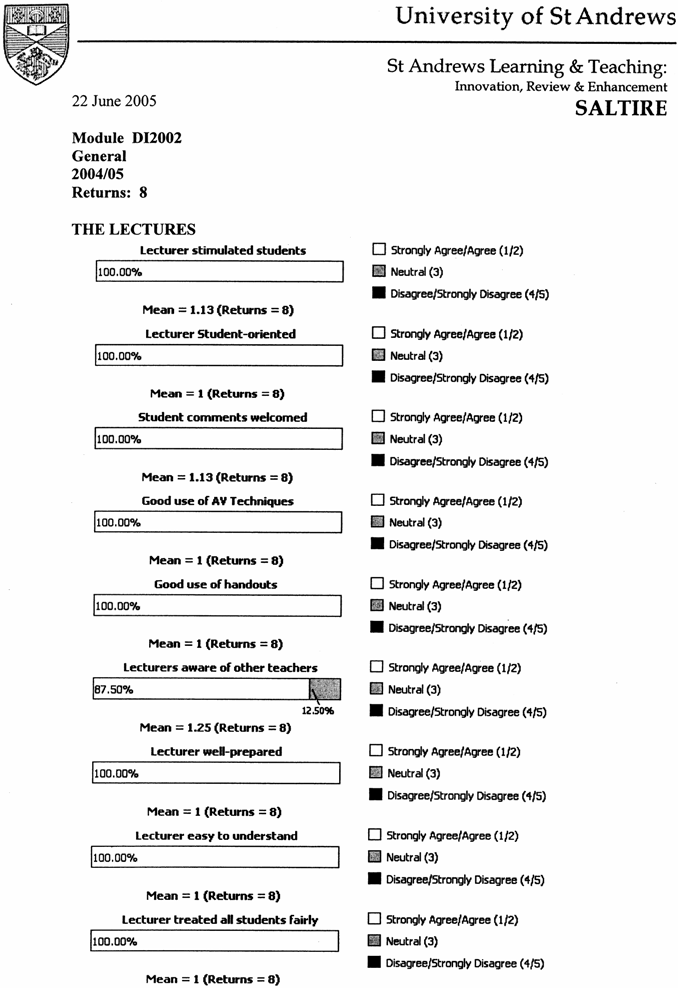
The content of the lectures was
varied. Thanks to Mr. Blakley’s adept handling of the material, students were
able to absorb a wide range of material in terms of grammar, vocabulary,
translation, writing, and reading aloud and silently. Language acquisition
was encouraged by Mr. Blakley’s enthusiasm, creative use of songs and
animations, and generally encouraging attitude. Every
Friday lecture involved working through a portion of the Book of Jonah, which
had been assigned for translation. By the end of the course, students handed
in a complete translation of Jonah, which they were responsible for
translating themselves. This helped students gain an in depth familiarity
with the text of a Biblical book and gave them a sense of accomplishment at
having successfully translated one. For
students who wanted to do more Biblical translation, Mr. Blakley gave an hour
of his time every Friday from 16:00–17:00 for “Hebrew 2½.” This optional
class gave students who desired it an extra hour per week of translation help
on Biblical texts that were outside the syllabus. All students who attended
Hebrew 2½ were extremely grateful for Mr. Blakley’s effort. Mr.
Blakley’s teaching style appeals to a wide range of learning styles. For
those who learn language best by hearing and speaking, there was regular
singing, reading and speaking practice. Students noted that they would like
more songs, as these were particularly helpful with language acquisition. For
those who learn best through visual aids, there were regular handouts and
audio-visual presentations that made use of colours
and animations. For those who learn best through traditional written
exercises, these were also sufficient. Students with special needs commented
that they felt very fairly treated and superbly accommodated. Mr.
Blakley faced the challenge of teaching students with different Hebrew
backgrounds and bringing them all to the same level of Hebrew proficiency.
One student commented that he did a particularly good job of this. He/She
said that it helped that Mr. Blakley is extremely proficient in Hebrew
himself and was able to fill in knowledge “gaps” wherever they appeared. If a
student asked a question to which Mr. Blakley did not immediately know the
answer, he always returned to the next class having researched it. |
|
The Tutorials |
|
|
|
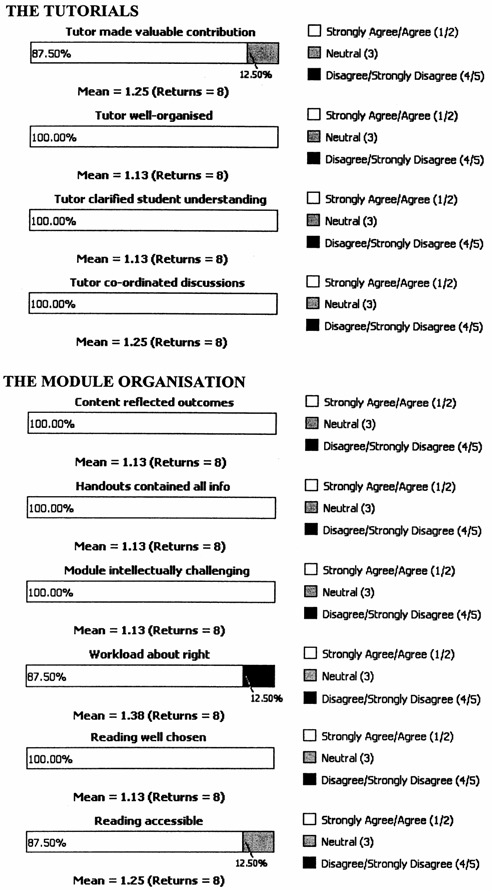
In Mr. Blakley’s words, the tutorials
addressed “special topics.” Examples of these include “How to use the BHS,”
“How to use the BDB,” and “The history of the transmission of the Hebrew text
of the Old Testament.” Students found these topics particularly useful in
helping them apply their knowledge of Hebrew. Some students noted that their
previous Hebrew course had engaged neither the BHS nor the BDB, and that this
course did so in such a way that students gained familiarity with them
quickly. |
|
The Module Organization |
|
|
|
There was a general complaint
among students that the workload for the module was very heavy. However,
students qualified this complaint in two ways. The first was in gratitude to
Mr. Blakley for making his own module evaluation in the second week and lowering
the workload in response to student complaints. The second was in recognition
that Hebrew proficiency at the required level demands a substantial workload.
It was suggested by one student that the course be re-assigned a credit value
of 25 in recognition of this workload. All students agreed that this would be
a fair recognition of the effort required by the subject matter. The
possibility was also suggested that students be awarded a certificate of
Hebrew proficiency that carried no credit, but recognized their hard work. One
of the students complained that the “book load” was also heavy (in terms of
mass). When we were required to bring all of the books to a class (textbook,
workbook, BHS, BDB), he/she found it difficult. |
|
Assessment |
|
|
|
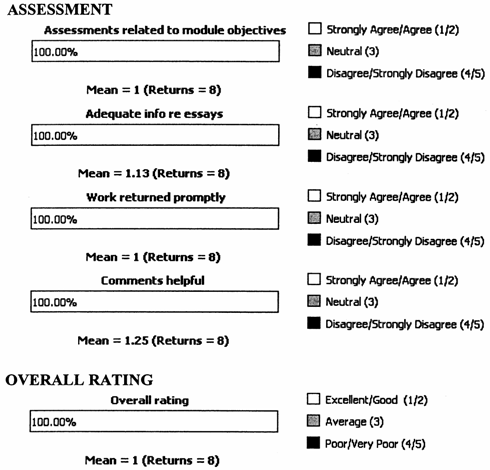
Students appreciated the weekly
assessment because it provided accountability and helped with language
acquisition. One student asked whether or not the weekly grammar quiz could
be combined with the weekly vocabulary quiz into one weekly quiz that tested
half as much of each. Most students agreed that this would not effect
language acquisition in any significant way and would make the assessment
more bearable. However, a few students saw nothing wrong with the current
method of twice-weekly assessment. The
two quarterly assessments went uncommented on, except to say that they were
fair. In terms of the final exam, one student complained about the pointing
section saying that this was too much to expect of students. |
|
The Lecturer/Tutor |
|
|
|
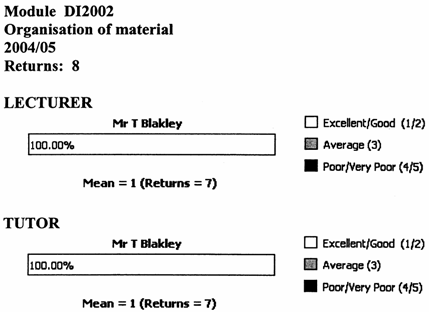
One student commented, “Ted works
harder for us than any paid lecturer.” He was the only lecturer of any
student who asked for all the dates of essays and tests from all of his
students’ other classes and scheduled assignments and assessments around them
so as not to conflict with any other course. Another
student commented, “His technological resources are second to none.” Mr.
Blakley has set up an amazing WebCT site called
“Hebrew 2 Hub”. Among other things, this site includes a class schedule, an
assignment schedule, vocabulary lists, vocabulary flash cards, the course
syllabus, lecture slides, online Hebrew resources, the Hebrew text of Jonah
from the BHS and the Leningrad Codex, an un-pointed Jonah text for pointing
practice, a wide-line Jonah text for translation practice, the Septuagint
text of Jonah, weekly translation helps, the chapter on Jonah from Einsphar’s Index to
Brown, Driver, and Briggs Hebrew Lexicon, a word list of all the Hebrew
words that occur in Jonah with their basic definitions and frequencies, audio
recordings of Jonah divided by chapter as well as by shorter passage and
available at half-speed and full-speed, grammar charts on morphology,
pronouns, pronominal suffixes, nouns, syntax, and extensive verb paradigms.
Mr. Blakley works diligently to keep the Hebrew 2 Hub up-to-date with
everything that is happening with the class. |
|
Other Comments |
|
|
|
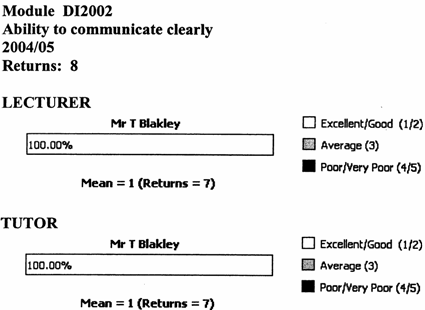
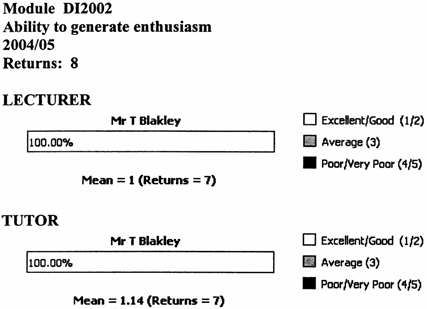
Out of all of the questions on
eight Module Evaluation Forms (a total of 240 questions), Mr. Blakley
received exactly 13 ratings that were not either a 1 or, in some cases a 0
which had been written in to show superior performance to a 1. He did not
receive any fives, and he received six perfect evaluation forms. Every
student rated the module with a 1 overall. Many
students remarked, “Had it not been for Ted, I would have dropped the class.”
One student wrote, “J. Ted Blakley has constructed an entertaining,
engrossing and challenging course which meets and exceeds all expectations.
Thoroughly enjoyable yet intellectually stimulating this course has been the
best module I have studied in the university to this date.” Another student
also said that this was the best course he/she had taken in the university,
and two students said that it was the best language course they had taken in
the university. All students agree that Mr. Blakley is a superior Hebrew
lecturer and tutor. He has a special talent for teaching Hebrew, which, when
combined with his laudable work ethic and extreme approachability, makes for
a uniquely successful course. |
|
COURSE EVALUATION HEBREW 2 — SPRING 2005 UNIVERSITY REPORT |
|
|